How a Women-Owned Business is Changing Family Law in Washington State
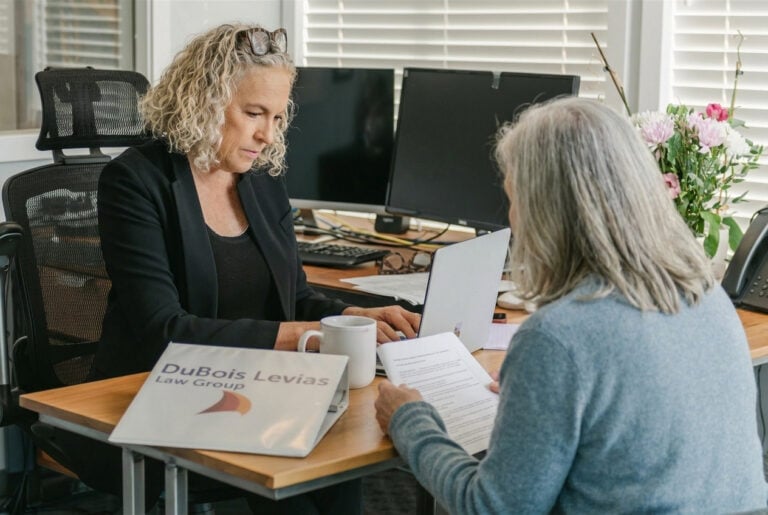
Until the Women’s Business Ownership Act passed in 1988, many women needed a man to co-sign a business loan. When Amanda DuBois founded this family law practice in 1995 in Seattle, Washington, that law was only seven years old. For National Women’s Small Business Month, get behind the women-lifting-women origin story of DuBois Levias Law Group (DLLG) — now one of the longest standing women-owned law firms in Seattle. Find out how we’ve worked differently to raise the bar for compassion, care, and real equity for both divorcing clients and divorce attorneys in Seattle, Edmonds, Port Townsend, and beyond.
The legal world looked different for women 30 years ago. The 1989 Gender and Justice report from the Washington State Task Force showed that court staff and opposing counsel called women attorneys “dear,” “young lady,” and “girls.” They addressed them by their first names while referring to male lawyers by their surnames. More than 50% of women lawyers said this treatment at least occasionally affected case outcomes. The committee (somewhat obviously) concluded: “Women are afforded less credibility than their male peers.”
According to the same report, divorce outcomes for women looked different too. Only 10% of wives received maintenance, averaging just 2.6 years. Almost half of judges knew of mothers giving up over 50% of the property to avoid a custody fight.
Around that time, Amanda DuBois was in her own fight to get her fair, earned share out of the practice she had just left. An entrenched “old boys’ club,” her all-male partners of the medical malpractice firm wrote in a mediation brief that she was just “a dilettante doctor’s wife dabbling at the law.”
Now more than 30 years later, the firm she founded has changed countless lives and the practice of family law in Washington state, proving them wrong time after time.
The Picture for Women Lawyers 30 Years Ago Versus Now
In the mid-1990s, according to Duke University law professor Katharine Bartlett, women made up less than a quarter of lawyers, and about 12% of law firm partners. A long-term University of Michigan study of salaries from law school graduates showed that 15 years after graduating, men earned 52% more than women. Even when factoring in similar hours, achievements, and family situations, men still earned 17% more.
Advancement has never been straightforward for women in law. A 1995 report to the New York City Bar Association’s Committee on Women in the Profession found that senior partners were ambivalent about becoming mentors to women, partially because of gender stereotyping and a perception that women were at a disadvantage “in becoming rainmakers.”
It’s still rough out there. Even though women have been the majority of law school students since 2016, now making up over half of salaried associates, they are still a distinct minority as law firm partners, just under 30% according to the latest 2025 NALP survey.
“Women report being four to eight times more likely to be overlooked for advancement, denied a salary increase or bonus, treated as a token representative for diversity, lacking access to business development opportunities, perceived as less committed to her career, and lacking access to sponsors,” the ABA Journal reported on a 2019 study.
Today, female lawyers still make 80 cents on the dollar of their male counterparts. Even women partners earn 29% less than men in the same position. The gap remains unexplained — and burnout for women lawyers is (not surprisingly) disproportionally high. That’s exactly what we set out to change at DLLG.
How Lived Experience Makes Family Law Better in Practice
Most of the attorneys at DuBois Levias Law Group have an entirely different “before the law” career on their resume, especially our three partners. Amanda was a high-risk labor and delivery nurse. Lucia Ramirez Levias was a nonprofit advocate with an international relations background. Freya Wormus was a professional dancer turned finance manager at an artist’s organization.
“Nurses are actually trained in empathy,” Amanda says in an interview with Authority Magazine. “Family law is emotional, high-stakes work. But my roots as a nurse taught me how to walk people (both clients and team members) through chaos with a steady hand, and over three decades, I’m proud of the difference we’ve made in so many families’ lives as they transition from married to divorced, parents to co-parents.”
Lucia spent a decade in the nonprofit sector working with families and children, and grew up in a family that spanned Peru and the US. “I know firsthand the lifelong impact these transitions have on children and parents alike,” she comments in the Off the Fence podcast. “I tried out immigration law and realized it wasn’t what I was expecting it to be. And someone said, hey, there’s a little firm over here in Seattle that is doing family law… I ended up finding that it was really aligned with my background, my interest. I just really like working with people. Family law is where you get to practice the law, but you also get to counsel. It was sort of a perfect mix for me.”
Freya earned her BA in Dance, performing and choreographing with a modern dance company before dedicating years to nonprofit finance work. She started as a law clerk at DLLG after graduating magna cum laude from Seattle University School of Law. Here, she quickly became a standout family law advocate, making partner just five years later.
“In my previous work at Artist Trust, I loved helping artists find the funding and momentum to bring their visions to life. Then, after supporting a close friend through a divorce, I made the jump to law school and became a family attorney,” Freya says. “At DLLG, we focus on bringing visions to life too. What can a healthy, happy other side look like for people going through divorce? And how can we help them get there? My financial background helps me drill down on how to achieve that for my clients in tangible, realistic ways. That lights me up.”
How Attorney Mentoring at DLLG Upends Cutthroat Law Firm Stereotypes
The work atmosphere at DLLG is miles away from the “crab-potting” culture of many law firms, where attorneys often undercut and hold each other back. Inspired by the medical residencies Amanda encountered in nursing, we pair new lawyers with senior attorneys so they have a year of mentoring to absorb the art of practicing law.
“That raises the standard for everyone, especially our clients,” Amanda says of the team-based model.
Parenthood and outside interests have long hampered legal careers and earning potential, so we support the actual lives of our attorneys through a remote work option. Our new Port Townsend office, alongside our Seattle and Edmonds locations, brings compassionate family law support to King, Snohomish, and Jefferson counties, giving our attorneys and our clients more room to grow where they live.
We also cheer on our team’s pro-bono work and passion projects. Amanda even writes award-winning legal thrillers that explore injustices in the system, inspired by seeing the plight of women in prison firsthand. Through her pro-bono work, she now helps change laws and the lives of formerly incarcerated people, and DLLG has become a proud “second-chance employer.”
It all comes back to empathy at DLLG. We understand what women in law, women in business, and women in divorce are going through on a fundamental level.
“Back then, there were no mentors for me. There simply weren’t any women to model myself after,” Amanda told Canvas Rebel, recalling the early ‘90s. “I pivoted from a traditional law firm hierarchy to something that resonated with my own style. We don’t throw a new lawyer into a situation to see if they will sink or swim.”
Thirty years later, the woman once dismissed as a “dilletante doctor’s wife,” who had no one to model herself after, is surrounded attorneys she helped elevate. Two of them now stand beside her as partners.
You Deserve a Team That Has Your Back
Whether you’re facing a divorce or building a career in family law, you deserve a team that has your back. At DLLG, women lift each other up, including our clients and our team. Schedule a consultation or check out our careers page to start your new direction.
Frequently Asked Questions About How DLLG Does Family Law
Q: Is DuBois Levias Law Group a women-owned law firm?
A: Yes. Amanda DuBois founded the firm in Seattle in 1995, and we’re now one of the longest-standing women-owned law firms in the area. Today we’re led by three women partners: Amanda DuBois, Lucia Ramirez Levias, and Freya Wormus. For more than 30 years, DLLG has focused exclusively on family law in Washington State.
Q: How does DLLG mentor new family law attorneys?
A: Inspired by the medical residencies Amanda worked alongside as a nurse, DLLG pairs new attorneys with senior lawyers for a year of hands-on mentoring. Rather than competing against each other, our attorneys work as a team, so newer lawyers build their skills with support instead of being left to sink or swim.
Q: Where are DuBois Levias Law Group’s offices?
A: DLLG serves clients throughout Washington from offices in Seattle, Edmonds, and our newest location in Port Townsend, which opened in 2026 to serve families on the Olympic Peninsula and in Jefferson County.